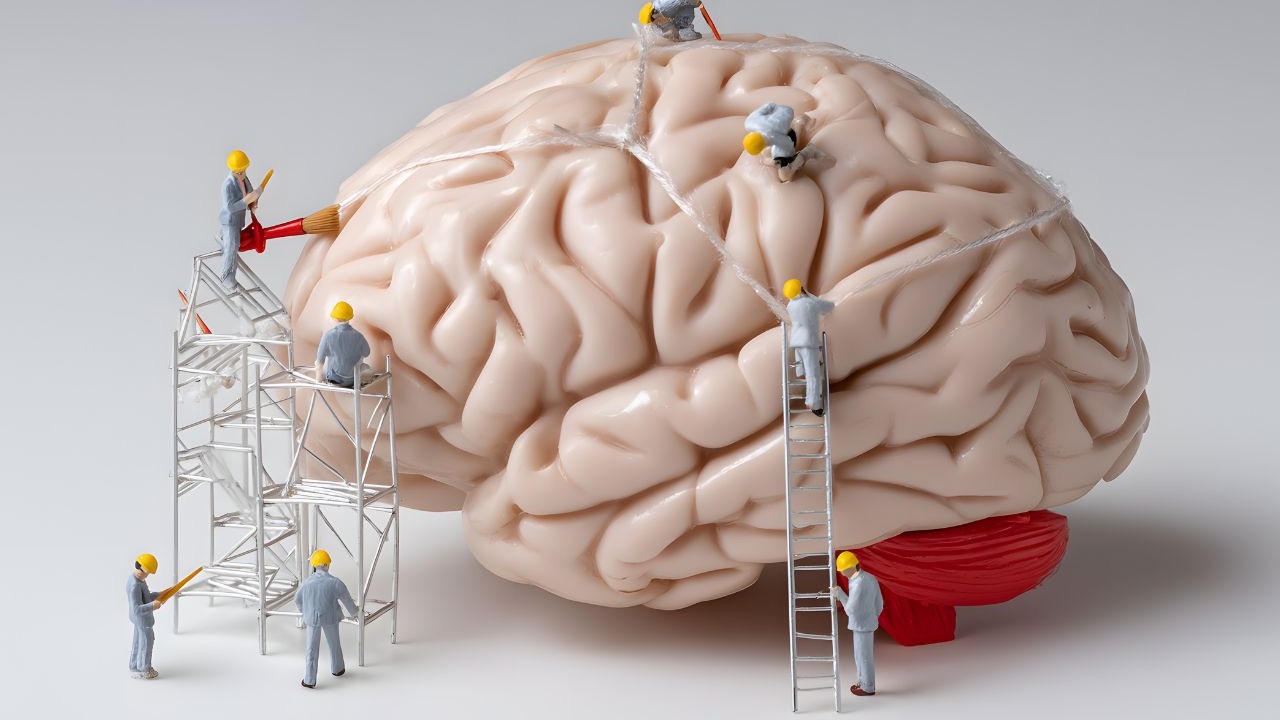
A Neuroconstructionist Approach to Impostor Syndrome

 October 15, 2026
Why competent people feel like frauds, and how to change it.
Impostor syndrome is a pervasive psychological phenomenon affecting people who, despite evident success, persistently doubt their abilities and fear being exposed as frauds. This internal sense of intellectual phoniness cuts across gender, age, and profession, and is marked by chronic self-doubt and a persistent fear of being found out. Left unaddressed, it can significantly impact well-being and performance.
The term was introduced in 1978 by psychologists Pauline Clance and Suzanne Imes, who described it as an internal belief that one is less competent than others perceive. It has since been widely studied; a systematic review by Bravata and colleagues (2020) found it to be common across populations, though prevalence estimates vary considerably depending on how it is measured.
However, knowing that impostor syndrome is widespread, and knowing its symptoms, still leaves a central piece unexamined: why does it persist in people who have overwhelming evidence of their own competence—and why does more success so often make it worse rather than better? Answering that requires looking not at the feeling itself, but at how the brain constructs it.
Why Common Approaches Often Fall Short
Many impostor-syndrome interventions treat the problem as a faulty part to correct: an overactive fear response to calm, distorted thoughts to reframe, low confidence to top up. This inheritance comes from faculty psychology, the outdated idea that the mind divides into separable faculties, which later thinkers tried to map to distinct parts of the brain. Its logic survives as essentialism, the habit of treating confidence, fear, and anxiety as fixed inner entities a person simply has.
Contemporary neuroscience offers a fundamentally different perspective. No psychological experience lives in one place in the brain; there is no fear region, confidence center, or impostor switch. Experience is constructed in real time by overlapping neural networks that draw on prior learning to predict incoming signals and interpret what they mean. From this view, the impostor feeling is not a malfunction but a protective response, built from what the brain once learned to read as risk. It is what the brain produces when visibility, high expectations, or evaluation are forecast as dangerous. The doubt, vigilance, and over-preparation are the bracing against that forecast, not proof that the danger is real.
That distinction matters, because tools aimed at the output often don’t hold. Reframing and emotion regulation depend on executive control, which becomes less reliable under precisely the conditions that prompt impostor feelings: stress, uncertainty, and evaluation. This is why progress so often plateaus, regresses under pressure, or fails to travel across contexts. The tools are not working on the layer generating the experience.
What the Impostor Feeling Actually Is
In the Neuroconstructionist model, experience is produced from conceptual priors in the brain's hierarchical generative model—learned, probability-weighted expectations about what things mean, which shape how the brain interprets signals from the body and the world before they fully arrive. The brain forms a fast situation forecast of what kind of moment this is, often before conscious thought arises.
For someone caught in the impostor pattern, the forecast is set early and held tightly: If I'm not certain, I don't belong. If I can't prove it, I'll be exposed. Once that prior is running, it doesn’t wait for evidence; it shapes what they notice. A neutral question in a meeting is heard as a test. A moment of hesitation is read as proof. Praise is discounted because it contradicts the forecast, while any hint of inadequacy is amplified because it confirms it.
Consider a coachee promoted twice in three years. Their projects have been held up as the standard, and they’ve just been handed their firm’s largest account. They have the wins list, the pre-meeting breathing routine, and the reframed self-talk. Yet internally, almost nothing shifts. Each success, rather than reducing the doubt, raises the bar they now have to clear to keep belonging. The achievements are real, but the underlying prediction—I have to keep proving I belong—was never updated, so every win is taken as a new standard to defend rather than evidence they are safe. This is why the feeling resists reassurance. The problem is a predictive model that discounts that evidence before it can land, weighting it down because it contradicts a forecast the brain holds with high confidence.
Where the Leverage Sits: Who Counts as ”One of Them”
One way the brain organizes meaning is especially well-suited to the impostor pattern: how it categorizes, and the prototypes it draws on. This is the sense of who counts as a “real” member of a group, and what a “real” one looks like.
Underneath “I don’t belong here” is often a rigid membership rule. Real executives are commanding and never hesitate. Real experts always know the answer. Real leaders don’t feel this nervous. Held to an idealized image of the “real” thing, the gap is read as proof of not belonging—however competent the person actually is. A prototype that narrow all but guarantees the verdict.
This is the lightest and often most effective place to intervene, because the rule can be made visible and the category widened without any attempt to calm anxiety or manufacture confidence. The work is not “you belong, believe it.” It’s: what, exactly, do you think you have to be to count here—and who counts that you’d describe differently? This is not reframing the thought or arguing the person into confidence. Those approaches depend on conscious effort and tend to fail under pressure. It’s changing what the brain predicts, then letting a real experience, not persuasion, do the updating.
The high-achieving coachee’s prototype of a “real” account lead was someone who had every answer on demand. Naming that rule out loud was the first move. The second was widening it to include a version of belonging they could actually inhabit. The third, and the one that updates a prediction, was evidence—a single real attempt that let them act from the wider version and see what happened. When the rule is widened just enough to let them act, the result gives their brain something its forecast hadn’t predicted.
When the Pattern Runs Deeper
Widening who counts resolves many impostor patterns. But not all of them. Sometimes the belonging rule is held in place by something deeper: an evaluative axis (e.g., competent vs. fraudulent, worthy vs. unworthy) that has become moralized, so that not measuring up doesn’t just feel uncomfortable; it feels like disqualification. When that axis organizes someone’s whole sense of themselves across domains, a wider prototype isn’t enough on its own. That’s because the axis keeps regenerating the old rule.
The work then goes deeper. Not by flipping to the “good” pole, which leaves the axis intact and raises the stakes of staying on the right side of it, but by loosening the axis itself so that falling short of the standard stops registering as a verdict on their worth. The principle is the same at every level: change comes from updating the prediction underneath, then letting lived evidence confirm the update. The moment stops asking am I about to be exposed? and starts asking what’s actually needed here?
From Managing the Moment to Reconstructing the Experience
The Neuroconstructionist view reframes what impostor syndrome is and what resolving it requires. It is not a character flaw, a confidence deficit, or a set of broken thoughts to correct. It is a coherent construction, built from meanings learned, reinforced, and held in place because they once were protective—and a predictive system keeps running the model it already has until evidence makes updating worth the cost. Seen this way, the impostor feeling is not evidence that something is wrong with the person. It is evidence of a predictive model doing its job on outdated terms.
This is why the deepest change often arrives as relief rather than effort. The coachee who stops bracing before meetings hasn’t learned to hold the fear down more effectively; their brain has stopped forecasting the room as a threat. No confidence is manufactured, and no fear is suppressed. What changes is the prediction itself: what the brain now expects of the room, and of who they are in it. The effort that once went into defending against exposure is no longer called for.
That is the shift from managing impostor syndrome to resolving it. From correcting the output to reconstructing the source. Worked at this level, change tends to be quieter and more precise, and because it isn’t forced, it has a better chance of lasting. It also asks something different of coach and coachee alike. Not more willpower, nor more effort, but the patience to let evidence do what reassurance cannot.

Ramon David, MSc
Founder, BrainFirst Inc.
References
- Bravata, D. M., Watts, S. A., Keefer, A. L., Madhusudhan, D. K., Taylor, K. T., Clark, D. M., Nelson, R. S., Cokley, K. O., & Hagg, H. K. (2020). Prevalence, predictors, and treatment of impostor syndrome: A systematic review. Journal of General Internal Medicine, 35(4), 1252–1275.
- Clance, P. R., & Imes, S. A. (1978). The imposter phenomenon in high achieving women: Dynamics and therapeutic intervention. Psychotherapy: Theory, Research & Practice, 15(3), 241–247.
- Crocker, J., & Wolfe, C. T. (2001). Contingencies of self-worth. Psychological Review, 108(3), 593–623.
- David, R. (2026). Neuroconstructionist Coaching, Volume 1. BrainFirst Publishing. New York.
- Higgins, E. T. (1987). Self-discrepancy: A theory relating self and affect. Psychological Review, 94(3), 319–340.
- Ibarra, H. (1999). Provisional selves: Experimenting with image and identity in professional adaptation. Administrative Science Quarterly, 44(4), 764–791.